
Abhaneri Stepwell (Chand Baori): History, Timings, Tickets & Day Trip From Jaipur (2026)

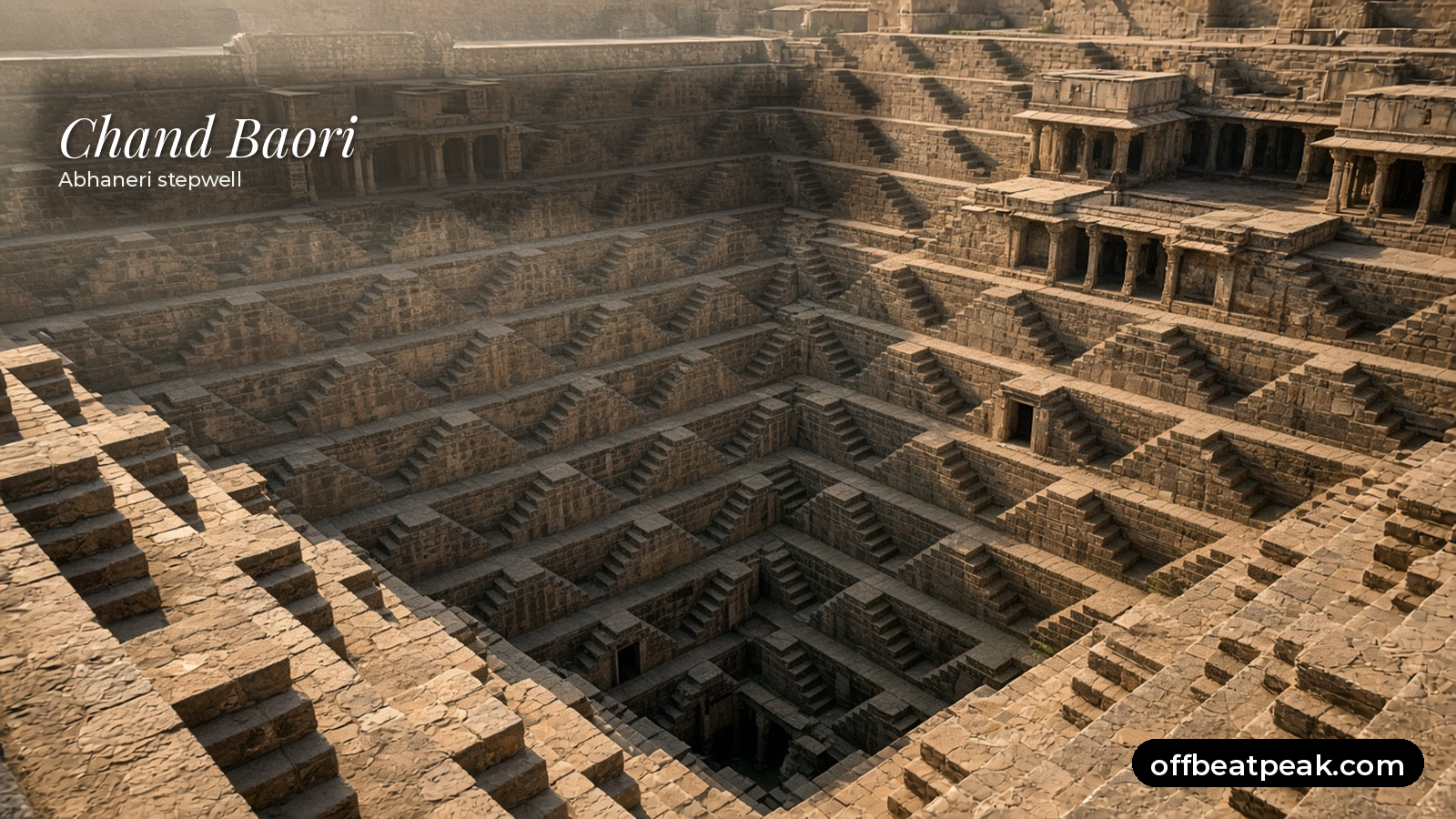
Thirteen storeys of zigzag steps dropping into a square of green water. Chand Baori is one of the most extraordinary structures in India.


In shortChand Baori is a 9th century stepwell in Abhaneri village, about 95 km east of Jaipur off the Jaipur to Agra highway. Built under Raja Chanda of the Nikumbha dynasty, it has around 3,500 steps on 13 levels and is about 20 m deep. It is an ASI monument open sunrise to sunset; entry is ₹25 for Indians and ₹300 for foreigners. Visitors cannot walk down the steps. Allow an hour with the Harshat Mata temple next door. It works as a half-day trip from Jaipur or a stop on the way to Agra or Bharatpur.
 Chand BaoriArchaeological Survey of IndiaChand Baori
Stepwells are found across western India, but none look quite like Chand Baori. Three sides fall away in a perfect geometric pattern of steps; the fourth holds a multi-storey pavilion of carved galleries.
Here is what to know about its history, visiting rules and how to fit it into a Jaipur trip. For other stepwells, see stepwells in Rajasthan.
01 · Key facts
Chand Baori Ticket Price and Timings
| Detail | Information |
|---|---|
| Indian | ₹25 |
| Foreign | ₹300 |
| Children under 15 | Free (ASI rule) |
| Timings | Sunrise to sunset, daily |
| Time needed | About 1 hour including Harshat Mata temple |
| Managed by | Archaeological Survey of India (ASI) |
Tickets are sold at the gate, often with an online or QR code option; cash and UPI usually work. The Harshat Mata temple next door is free. Local guides wait at the entrance and are worth hiring for the stories and carvings.
02 · Story
History of Chand Baori
Abhaneri, once called Abha Nagri (city of brightness), was ruled in the 8th and 9th centuries by the Nikumbha Rajputs. The stepwell is credited to Raja Chanda (or Chand), after whom it is named, and dated to around the 9th century. It was built to store monsoon water through the dry months in this semi-arid region, and the deep shaded steps kept the water, and those who gathered there, cool.
The arcaded galleries around the top were added much later, in the Mughal period, and now display carved stone panels and sculptures rescued from the ruined Harshat Mata temple. The temple itself, dedicated to the goddess of joy, was largely destroyed in the 11th century, traditionally blamed on the raids of Mahmud of Ghazni, but its surviving carvings are some of the finest early medieval sculpture in Rajasthan.
03 · Design
Architecture: Why It Looks Like That
1
The steps
About 3,500 narrow steps in double flights on three sides, forming repeating triangles down 13 levels.
2
Depth
About 20 m (roughly 64 feet) to the water at the bottom.
3
The pavilion
The north side has a multi-storey pavilion with jharokhas, balconies and royal rooms facing the water.
4
Cooling
The temperature at the bottom is said to be several degrees cooler than at the top.
5
Galleries
Later arcades around the rim house carved panels from the temple.
The steps let people reach the water at any level as it rose and fell with the seasons. The visual effect of the symmetry is so strong that the baori has appeared in films, including The Fall (2006).
04 · Know before you go
Can You Go Down the Steps?
No. The ASI has closed the steps to visitors for safety and conservation; you view the well from the galleries around the rim. Guards enforce this, and you should not offer or accept money to go down: it is against the rules, and the steps are steep, narrow and without railings.
05 · Next door
Harshat Mata Temple
Just beside the baori, the temple of Harshat Mata stands on a raised platform. Most of the original superstructure is gone, but the plinth and many carved pillars and panels survive, with dancers, musicians and deities in a fluid style typical of the early Pratihara period. It is still an active temple; remove shoes and dress modestly.
06 · Getting there
How to Reach Abhaneri From Jaipur
| Option | Time | Approximate cost |
|---|---|---|
| Private taxi (round trip) | About 1.5 to 2 hours each way | ₹2,500 to ₹4,000 for the car |
| Train to Bandikui, then auto | About 1 to 1.5 hours by train, plus 20 minutes | Train ₹50 to ₹400; auto ₹300 to ₹500 return |
| Bus to Sikandra, then auto | About 2 hours | Cheapest; slow |
All costs are approximate. Abhaneri is about 95 km from Jaipur: drive east on the Jaipur to Agra highway (NH 21) towards Sikandra and turn off for Abhaneri. Bandikui is the nearest railway station, about 8 to 10 km away.
07 · Plan
Day Trip From Jaipur, or a Stop on the Way to Agra
7 am
Before traffic.
9 am
Early light; fewer groups.
10 am
With a guide.
11 am
Back to Jaipur by 1 pm, or on to Bharatpur or Agra.
Abhaneri is roughly on the way from Jaipur to Agra, so many travellers stop here en route; it adds about an hour of detour. On a longer day from Jaipur, you can combine it with Bhangarh Fort, about 1.5 hours further.
08 · When
Best Time to Visit Chand Baori
October to March is the most comfortable season for the drive and the open, shadeless site. Within the day, early morning gives the softest light on the steps and the fewest tour groups; late afternoon lights the pavilion side. After a good monsoon (July to September), the well holds more green water, which adds reflections. Avoid midday from April to June, when the stone is fierce.
Rajasthan Tourism has in some years staged an Abhaneri Festival of folk music and dance at the baori in the autumn; check the official events calendar if you would like to time a visit.
09 · Photos
Photography Tips
Get the shot
- Shoot from the corners of the gallery to emphasise the diagonals.
- Use the pavilion as a frame for symmetry.
- A polarising filter helps with water and sky.
- People walking the gallery give scale; wait for a clean frame if you prefer.
- Tripods may be questioned; ask the guard.
10 · Longer day
Combine With Bhangarh or Bharatpur
| Add-on | From Abhaneri (approximate) | Why |
|---|---|---|
| Bhangarh Fort | About 1.5 hours | Rajasthan's famous "haunted" ruined town; must leave before sunset |
| Bharatpur (Keoladeo) | About 1.5 hours | UNESCO bird sanctuary, best in winter |
| Agra | About 2.5 hours | Taj Mahal |
| Bandikui | About 20 minutes | Railway town with heritage stays |
Times are approximate road times. A Jaipur to Agra drive via Abhaneri and Bharatpur makes a full but rewarding day.
11 · Verdict
Is Chand Baori Worth the Trip?
Yes, if you like architecture or photography: there is nothing like it in Jaipur, and photographs never quite capture the scale. Be clear about what you get, though. It is a single structure in a small village, you cannot go down, and the visit itself takes an hour; most of a half-day trip is driving. If you are travelling Jaipur to Agra anyway, it is an easy yes. If not, weigh three to four hours of driving against your other Jaipur plans.
12 · Practical
Practical Tips
Before you go
- Arrive early morning or late afternoon for soft light and fewer groups.
- There is little shade and few facilities; carry water.
- A wide lens or phone 0.5x mode captures the full well.
- Village children may ask for pens or money; politely decline.
- Drones need ASI permission.
Related guides
13 · Keep planning
Plan the Rest of Your Rajasthan Trip
To sum up: Chand Baori is a 9th century stepwell in Abhaneri village, about 95 km east of Jaipur off the Jaipur to Agra highway.
Plan the rest of your trip.
Rajasthan guide
Stepwells in Rajasthan
Every major baori.
Rajasthan guide
Panna Meena ka Kund
The stepwell in Amer.
Rajasthan guide
Things to Do in Jaipur
Day trips and more.
Rajasthan guide
Jaipur Travel Guide
The full city guide.
14 · The questions
Abhaneri Stepwell (Chand Baori): Frequently Asked Questions
What is the Chand Baori ticket price?
₹25 for Indians and ₹300 for foreigners.
What are Chand Baori timings?
Sunrise to sunset, daily.
How many steps are in Chand Baori?
About 3,500 steps over 13 levels.
How far is Abhaneri from Jaipur?
About 95 km, roughly 1.5 to 2 hours by car.
Can you go down the steps at Chand Baori?
No, the steps are closed to visitors.
Who built Chand Baori?
Raja Chanda of the Nikumbha dynasty, around the 9th century.
Is Chand Baori on the way to Agra?
Yes, near the Jaipur to Agra highway; a short detour.
What is the best time to visit Chand Baori?
October to March, early morning or late afternoon.
Is there food at Abhaneri?
Only small tea and snack stalls; eat in Jaipur, Bandikui or on the highway.
Do I need a guide at Chand Baori?
Not essential, but local guides explain the history and point out the best carvings for a modest fee.
15 · Sources
Sources and References
- 1
- 2
- 3
Photos: Abhaneri-Chand Baori-06-Galerie-2018-gje by Gerd Eichmann (CC BY-SA 4.0); The head-spinning Chand Baori steps by Arpita Roy08 (CC BY-SA 3.0); Abhaneri (2022-07-15) Harshat Mata ki Mandir -- img 02 by Chainwit. (CC BY-SA 4.0). All via Wikimedia Commons.