
Bhangarh Fort, Alwar: History, Timings, Tickets & Complete Guide (2026)

India's most famous "haunted" fort is really a beautifully preserved ghost town, with temples, bazaars and a palace in a bowl of the Aravalli hills.

In shortBhangarh Fort is a ruined 16th and 17th century town in Alwar district, founded around 1573 and associated with Man Singh I and his brother Madho Singh I. It was largely abandoned within decades, and legends of a curse made it famous as a haunted site. The Archaeological Survey of India (ASI) manages it and bans entry after sunset. Sources quote hours of 6 am to 6 pm or 9 am to 5 pm, so plan for daylight only. Tickets are about ₹20 to ₹25 for Indians and ₹250 to ₹300 for foreigners. It is roughly 85 km from Jaipur and 90 km from Alwar. Figures are approximate.
 Bhangarh FortBhangarh Fort ticketsBhangarh FortBhangarh Fort
Bhangarh attracts visitors for its ghost stories, but the real reward is walking through an almost complete 17th century town: a bazaar street with roofless shops, temples with fine carving, and a palace climbing the hillside.
This guide separates history from legend and covers timings, tickets, what to see and how to get there.
01 · The facts
History of Bhangarh
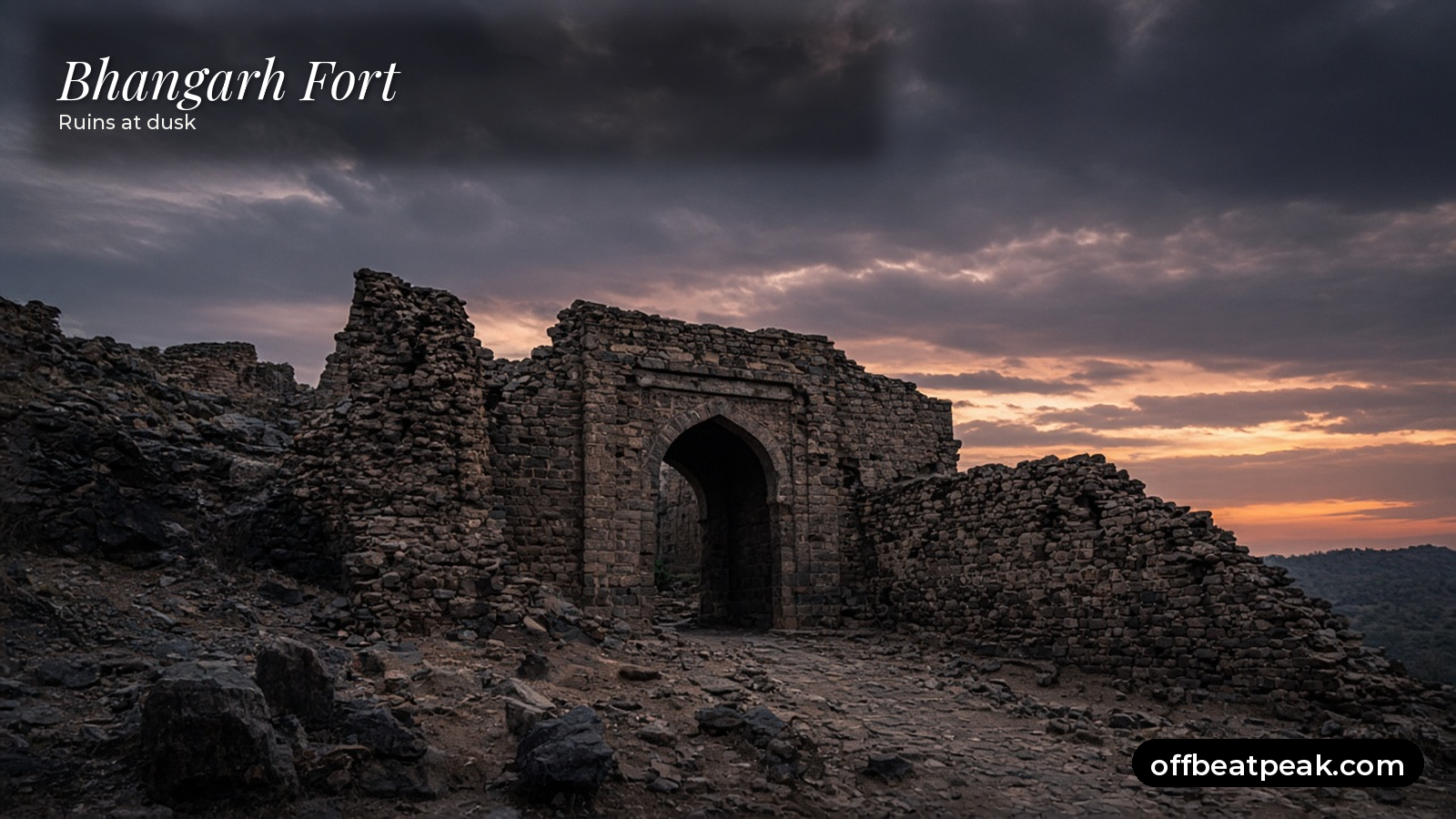
Bhangarh was established in the late 16th century, with 1573 the date most often quoted. Sources link its founding to Man Singh I of Amber, a general at Akbar's court, and its development to his brother Madho Singh I, whose palace crowns the site. Utsav Camp Sariska says the town declined after the death of Chhatr Singh in 1630, and a severe famine later in the 17th century hastened its abandonment.
Exact dates differ between sources and the documentary record is thin, so treat them as approximate. What is clear is that Bhangarh was a planned town with walls, gates, markets, havelis and temples, and that it emptied relatively quickly.
02 · The stories
The Haunted Legends
Two legends dominate. In one, an ascetic named Guru Balu Nath (one source says Balak Nath) allowed the town to be built on condition that no building cast a shadow on his retreat; when a palace did, the town was cursed. In the more widely told story, a sorcerer named Singhia fell in love with Princess Ratnavati and enchanted a potion for her. She poured it onto a rock, which rolled down and crushed him, and he cursed Bhangarh with his dying breath.
These are folk tales, not history. There is no evidence of anything supernatural, and the ASI night ban is a standard safety rule for an unlit ruin in hilly forest, even if it adds to the mystique.
03 · Inside
What to See Inside
Highlights
- Bazaar street: rows of roofless shops lining the main approach.
- Gopinath Temple: a Vishnu temple, among the best preserved, with carved outer walls.
- Someshwar Temple: a Shiva temple beside a natural spring and pond.
- Mangla Devi Temple: on a high terrace, with valley views.
- Royal palace of Madho Singh: the topmost ruin, with arched doorways and the best views.
- Havelis and the Nartakiyon ki Haveli (dancers' hall) along the way.
04 · Plan
Bhangarh Fort Timings and Ticket Prices (2026)
| Detail | What sources say |
|---|---|
| Opening hours | 6 am to 6 pm (Utsav Camp); 9 am to 5 pm (Staybook) |
| Night entry | Prohibited after sunset by the ASI |
| Indians | About ₹20 to ₹25 |
| Foreigners | About ₹250 to ₹300 |
| Facilities | Food stalls near the entrance; none inside |
The small fee differences likely reflect online versus counter pricing, which the ASI often sets at slightly different rates, but we could not confirm the current figures from an official page. Plan to arrive in the morning and leave well before sunset.
05 · Directions
How to Reach Bhangarh Fort
| From | Distance (approx.) | Time (approx.) |
|---|---|---|
| Jaipur | 85 km | 2 hrs |
| Alwar | 90 km | 2 hrs via Rajgarh |
| Sariska | 55 to 65 km | 1.5 hrs |
| Delhi | 280 km | 4 to 5 hrs |
Dausa is the usual railhead for Jaipur and Delhi trains, with taxis from there. Distances to Dausa quoted online vary widely, so allow time. Public buses exist but are infrequent; a taxi is most practical.
06 · Walk
How the Site Is Laid Out
Bhangarh sits in a valley where the Aravallis form a natural wall on three sides. You enter through a main gate (several gates once guarded the town) and walk uphill along the bazaar street, passing havelis and temples, before reaching the palace terraces at the top. The full walk up and back takes about 1.5 to 2 hours at an easy pace, longer if you explore side lanes and climb to the upper palace levels.
| Stop | Approx. time |
|---|---|
| Main gate to bazaar | 15 min |
| Gopinath and Someshwar temples | 30 min |
| Palace and upper terraces | 45 min |
| Return walk | 20 min |
07 · Combine
Places to Combine With Bhangarh
Within an hour or two
- Ajabgarh Fort: a quieter ruined fort on a nearby hilltop, a few km away.
- Sariska Tiger Reserve: about 55 to 65 km; jeep safaris run from October to June, with weekly closures.
- Neelkanth temples: early medieval Shiva temples near Sariska.
- Abhaneri stepwell: Chand Baori, a good stop on the Jaipur route.
One source places Abhaneri about 20 km from Bhangarh, which looks too short given the road network; allow at least 1 to 1.5 hours by car between them.
08 · Plan
Sample Plans
| Plan | Route |
|---|---|
| Day trip from Jaipur | Leave at 7 am, Abhaneri, Bhangarh by late morning, back by evening |
| Sariska weekend | Day 1 Sariska safari; Day 2 Bhangarh and Ajabgarh |
| From Delhi | Overnight in Alwar or Sariska, Bhangarh next morning |
09 · Practical
Visitor Tips
Good to know
- Wear sturdy shoes; paths are rocky and uneven.
- Carry water and a hat; shade is limited.
- Watch for monkeys, especially around food.
- Avoid climbing on fragile walls for photos.
- Leave before sunset; guards clear the site.
- Do not believe touts selling "ghost tours"; night entry is illegal.
10 · Design
Architecture and Town Planning
Unlike many Rajasthan forts that are single citadels, Bhangarh is a fortified town. Concentric walls once enclosed the palace precinct, the residential quarters and the market. The temples are built in a North Indian Nagara style with curved spires and carved friezes, and several are in noticeably better condition than the secular buildings, partly because temples were built of finer stone. Water from the hills fed tanks and the spring beside the Someshwar Temple, which still flows.
11 · Camera
Photography Tips
Morning light from the east lights the bazaar street and temple facades well. The best overview is from the upper palace terraces, looking back down the valley toward the gate. A wide-angle lens helps in the narrow temple courtyards. Drones need permission from the ASI and are generally not allowed.
12 · Peace of mind
Is Bhangarh Safe?
Yes, during the permitted daylight hours. It is a well-visited ASI site with guards at the gate and other tourists on the paths. The real risks are ordinary ones: uneven ground, heat, and monkeys. Solo travellers should keep to the main paths and avoid wandering into the surrounding scrub late in the afternoon.
13 · Eat
Food and Facilities
There are small food stalls and tea shops near the entrance, selling snacks, water and simple meals, but nothing inside the fort. Toilets are basic. If you are driving from Jaipur, eat breakfast on the highway or at Abhaneri, and carry enough water for the climb to the palace terraces.
14 · Read next
More on Bhangarh
Related guides
- Bhangarh Fort haunted story: the legends and what is true.
- Alwar to Bhangarh Fort: how to get there from Alwar.
15 · Timing
Best Time to Visit
October to March is best, with temperatures roughly 10 to 25°C. April to June often exceeds 40°C, and the site has little shade. The monsoon turns the hills green and is atmospheric, but paths get slippery. Arrive early for soft light and fewer crowds; weekends are busy with day-trippers.
16 · Keep planning
Plan the Rest of Your Rajasthan Trip
To sum up: Bhangarh Fort is a ruined 16th and 17th century town in Alwar district, founded around 1573 and associated with Man Singh I and his brother Madho Singh I.
Explore east Rajasthan.
Rajasthan guide
Alwar
Forts and Sariska.
Rajasthan guide
Abhaneri Stepwell
Chand Baori on the way.
Rajasthan guide
Forts in Rajasthan
More forts.
Rajasthan guide
Offbeat Places in Rajasthan
Hidden gems.
17 · The questions
Bhangarh Fort: Frequently Asked Questions
Is Bhangarh Fort really haunted?
There is no evidence of anything supernatural; the stories are local legends.
Why is entry banned at night?
The ASI prohibits entry after sunset, a safety rule for the unlit ruins.
What are Bhangarh Fort timings?
Sources say 6 am to 6 pm or 9 am to 5 pm; plan for daylight only.
What is the Bhangarh entry fee?
About ₹20 to ₹25 for Indians and ₹250 to ₹300 for foreigners.
Can I do Bhangarh as a day trip from Jaipur?
Yes, it is about 2 hours each way.
How long do I need at Bhangarh?
About 1.5 to 2 hours on site.
What is near Bhangarh Fort?
Ajabgarh Fort, Sariska Tiger Reserve and the Abhaneri stepwell.
Who built Bhangarh Fort?
It is associated with Man Singh I and his brother Madho Singh I of Amber, from around 1573.
Is there parking at Bhangarh Fort?
Yes, there is parking near the main gate.
Do I need a guide at Bhangarh?
Not essential, but a local guide can explain the buildings and legends.
18 · Sources
Sources and References
- 1
- 2
- 3
- 4
- 5
Photos: Bhangarh Fort - Royal Palace Bhangarh (July 2022) - img 02 by Chainwit. (CC BY-SA 4.0). All via Wikimedia Commons.